How Photovoltaic Panels Turn Sunlight Into Electric Current
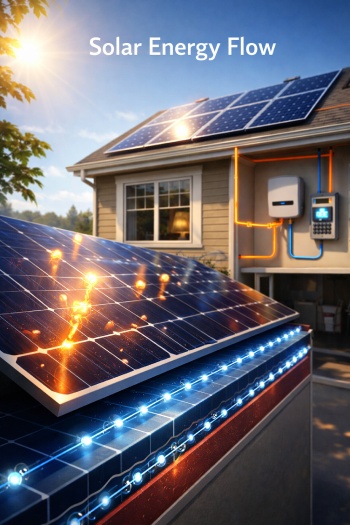
There is an intrinsic process in which sunlight actually delivers energy to solar cells-an occurrence at the atomic scale that results in electricity being dispensed without fuel, combustion, or moving parts.
What Happens Inside a Solar Cell
Sunlight is made up of photons, which are tiny packets of energy that travel from the sun at the speed of light. When photons strike a photovoltaic (PV) cell, they transfer their energy to electrons inside the cell's semiconductor material, which is almost always silicon.
Silicon is a natural semiconductor, meaning it conducts electricity under certain conditions. PV cells are built from two layers of silicon treated with different chemical impurities. One layer carries a slight negative charge, the other a slight positive charge. This creates what's called a p-n junction - a built-in electric field sitting between the two layers.
When a photon knocks an electron loose, that electric field pushes the electron in a specific direction. Electrons moving in one direction is, by definition, an electric current. That current is called direct current, or DC, meaning electrons flow in a single, steady direction.
Why Panels Produce Electricity Without Moving Parts
There simply is no turbine spinning here, no stream produced. The whole process works off of electronic means: Photons hitting silicon atoms, shunting an electron, and then following the electric field gradient, right? All this happens billions of times over the surface of a single cell.
Naturally, only about 0.5 volts are produced in that one cell. Because of this, manufacturers assemble dozens of cells and have called the whole thing a module; modules are combined together now to form panels. Residential ones are pretty normal, containing 60-72 cells for a total of 300-400 watts under direct sunlight.
Another feature of these cells is that it generates DC power. However, most of the electrical home appliances run on alternating current or AC, where the flow of electrons changes direction very rapidly. And that's the critical difference being the reason why an inverter should be an integral part of any solar-based system.
From DC to Usable Power in Your Home
The electricity generated by solar panels does not go straight into your appliances as-is. Instead, it first passes through an inverter, a device that converts direct current (DC) into alternating current (AC). This conversion is essential because household systems, electrical grids, and most devices are designed to operate on AC power. Without this step, the electricity produced by your panels would not be compatible with everyday use.
Once converted, the electricity flows into your home’s electrical panel, where it is distributed to power lights, appliances, and other systems. If your panels produce more electricity than your home needs at a given moment, that excess can either be sent back to the grid or stored in a battery system for later use. This final stage completes the process, turning sunlight into a reliable, usable energy source that integrates directly with modern electrical infrastructure.
How the Rest of the Solar System Makes That Power Usable
The question of finding the best pathway is followed by some general implications concerning the basis of all grid pricing. One important effect generated for consumers is that as they need more DG, power grows, and their required amplification savings disappear into full retail. And once distribution firms need to learn a climate-financial system in order to locate and use DG more economically than the utility giant, generation costs will no more need to be built due to distribution losses.
The Main Components Around the Panels
Racking connects one or more panels and tilts them to receive optimum sunlight. The racking structure aids in attaining the right orientation of modules on a rooftop or on the ground. It may sound simple, but the angle and orientation are directly related to how much solar radiation is collected in a year. Panels in Canada are often inclined to between 30 and 50 degrees. This accounts for the much lower solar angles seen during the winter months.
The wire network interconnects each panel in a string, directing the generated current down towards the inverter. The DC disconnect switches sit along that path to allow the system to be de-energized by technicians or firefighters quickly if anything ever misbehaves. Any of the current safety disconnect types are required by the Canadian Electrical Code.
The monitoring device usually communicates with the inverter or is mounted separately but allows for real-time tracking of the actual energy contribution of the system. Homeowners have access to this data on handheld devices when these apps are enabled, which makes it trivially common to see, for example, should the output drop abruptly.
Why Inverters Matter
Panels produce direct current, or DC. Homes and the electrical grid run on alternating current, or AC. An inverter bridges that gap. Without one, the electricity generated by a panel is essentially unusable in a standard home.
String inverters connect a series of panels in a single chain and convert their combined DC output into AC. They are cost-effective but can underperform if one panel in the string is shaded.
Microinverters attach to each panel individually. Shading one panel does not drag down the rest, which makes them well-suited to roofs with partial shade from trees or chimneys.
Hybrid inverters add battery management to the conversion process, directing excess power into storage rather than sending it straight to the grid.
How Energy Storage and the Grid Complete the System
Once electricity has been converted into AC, the system still needs a way to manage timing. Solar production does not always line up with when energy is used. Midday output is often highest, while household demand tends to peak in the morning and evening. That mismatch is where batteries and grid connections come into play, acting as balancing tools rather than generation sources.
Battery storage systems allow excess electricity to be saved and used later, reducing reliance on the grid during low-production periods like nighttime or overcast days. In grid-connected systems without batteries, surplus electricity is typically exported to the utility network, often through net metering arrangements. In both cases, the goal is the same: ensure that the energy captured during sunny periods is not wasted but instead integrated efficiently into a consistent, reliable power supply.
How Electricity Flows Through a Home and the Grid
In a home system, once the DC electricity is converted to AC electricity, it surges into the house panel, inclined to act like any local source of electricity. At that point, the path taken is determined by how much of the electricity the home requires to meet a particular demand.
What Your Home Uses First
Appliances running during daylight hours draw from solar production before anything else. If your solar panels are generating 2.4 kilowatts and your home is consuming 1.8 kilowatts - running a refrigerator, a few lights, and a laptop - the system covers that load entirely from the panels. The grid is not involved at all during those moments.
This real-time priority is automatic. No switch is flipped manually. The electrical panel simply receives solar-generated AC power first, and the grid fills in only when that supply falls short.
What Happens When Production Exceeds Demand
A few hours into a clear July afternoon, the panels attending to push out more current than a house usually consumes. And the excess does not go to waste, because net metering facilities-e.g. in most Canadian provinces, including Ontario and British Columbia-allow the excess current to enter the utility grid by passing through the meter.
In plain talk, the electrical grid is the network consisting of large transmission lines, substations, and the distribution infrastructure that connected power producers to homes and businesses. Sort of like a shared electrical highway, but instead of going toward your place, this time the power is going the other way, and as the power goes back toward the highway, reverse running of your utility meter temporarily serves to credit this supply in your account.
When Solar Production Falls Short
After sunset, or on overcast winter days in cities like Calgary or Ottawa, panels produce little or nothing. The home then draws power from the grid normally, as it always has. The transition is seamless - most homeowners never notice it happening.
Net metering credits earned during high-production months can offset those higher-consumption periods, which is part of why the annual billing cycle matters more than any single day's output.
What Affects Solar Output in Cloudy Weather and Canadian Winters
Hazy skies would cut the energy falling on a solar panel's surface; but, production will not fall to zero. Panels can convert diffuse light into electricity-reduced in yield due to the scattering of insolation through cloud cover. Output power normally drops to a figure somewhere around 10-25% of the maximum capacity on overcast days; on partly cloudy days, that value would be as high as 50-70%, provided the system stays up.
Do Panels Work on Cloudy Days?
Germany installs more solar capacity per capita than almost any other country, despite notoriously grey winters. That fact alone should put the "clouds kill solar" concern to rest. Photovoltaic cells respond to light intensity, not direct sunlight specifically. Diffuse radiation still carries enough energy to drive the photovoltaic effect and push electrons through the circuit.
Coastal British Columbia, with its wet and overcast climate, still supports thousands of residential solar installations. Homeowners there typically size their systems slightly larger to compensate for lower average irradiance, which is a straightforward engineering adjustment rather than a dealbreaker.
Why Winter Output Is Different From Summer Output
Cold temperatures are actually good for panel efficiency. Silicon-based photovoltaic cells perform better in cool conditions because heat causes electrical resistance inside the cell. A panel rated at 400 watts in standard test conditions may slightly exceed that rating on a cold, clear January day in Calgary.
The real challenge in Canadian winters isn't the cold. Shorter daylight hours mean fewer peak sun hours per day - a system that generates 30 kilowatt-hours on a July day in Ontario might produce only 8–10 kilowatt-hours in December. Low sun angles compound this, since panels mounted at a fixed pitch receive radiation at a shallower angle during winter months.
Snow accumulation blocks panels entirely until it slides off or melts. Roof pitch helps here - steeper roofs shed snow faster. Shading from bare trees, neighbouring structures, or dormers also becomes more significant when the sun tracks low across the southern sky. Orientation matters year-round, but south-facing roofs in Canada lose the least production across all seasons.
Solar Systems Work Best When You Understand the Flow
Each and every one part of the solar system dependent on the ones before it, and that interlinkedness surpasses any single part. The panels absorb sunlight and convert it into DC electricity through photovoltaic cells. An inverter transforms this accumulated DC power into the form of AC-usable electricity for the house. In case the appliances are not consuming it in real time, the excess electricity is supplied to the grid, with net metering credits. The guise of wrong, weather and seasons limit output that an Edmonton or Ottawa winter in Canada will provide fewer peak sunlight hours than a July day, but solar systems remain convenient. They call forth accurate expectations. When correctly sized for the location's roof, the system operates with significant utility throughout the year, even if the weather does not cooperate.
A public park bench in China equipped with solar panels can generate electricity to charge mobile devices, using stored solar energy to provide a convenient power source for visitors.
— Science girl (@sciencegirl) March 30, 2026
pic.twitter.com/skaYLjsEMQ