From First Consultation to Site Assessment
Most homeowners start this process with a simple question: will solar actually work for my house? The consultation stage is where that question gets a real answer.
The Initial Consultation and Utility Bill Review
After numerous interactions and an in-depth analysis of the customer's energy patterns, the solar company seems to introduce a customer's utility-bill account. His installer must first verify the average monthly energy consumption throughout the past 12 months and monitor peak summer and winter usage contrasts as per kWh. This information largely shapes their entire decision making; you see, 900 kWh per month is entirely different from 1,500. So are you ready with an invoice to show some bills to installers?-sharing them rank things in actionmostly.
What Happens During the Site Assessment
After the initial conversation, most installers schedule either a remote or in-person assessment. Remote assessments use satellite imagery and tools like Google's Project Sunroof to estimate shading and roof angle without anyone visiting. They're faster, sometimes completed within a day or two. An in-person visit is more thorough and typically required before final system design is confirmed. A technician will inspect your roof, measure usable surface area, and check how much direct sun your home receives throughout the day.
Roof Condition, Orientation, and Electrical Panel Checks
South-facing roofs with a pitch between 15 and 40 degrees tend to perform best in North America, though east and west orientations can still work well. Shading from nearby trees or chimneys gets mapped carefully. Your electrical panel also gets reviewed, since older 100-amp panels often can't support a solar system without an upgrade first.
Common Issues That Can Delay a Project
Roof repairs are the most frequent delay. If your shingles are aging or there's underlying damage, most installers won't proceed until that's resolved. Panel upgrades, HOA approvals, and complicated roof geometry can each add one to three weeks. This whole phase typically takes anywhere from a few days to two weeks depending on scheduling and what the assessment turns up.
Estimating System Size and Early Production Forecasts
Once the site assessment data is in, the installer moves from general feasibility to rough system design. This is where your energy usage, roof layout, and sunlight exposure come together into a preliminary system size, usually expressed in kilowatts (kW). Using your past consumption patterns, they estimate how much of your electricity the system can realistically offset. A household using 10,800 kWh annually might be matched with a system designed to cover 80% to 100% of that demand, depending on roof space and budget.
At this stage, you’ll also see early production forecasts. These are modeled estimates of how much electricity your system will generate over the course of a year, factoring in local climate data, panel orientation, and shading losses. While not final, these projections give you a clearer picture of expected savings, system efficiency, and whether adjustments are needed before moving into detailed design and permitting.
How the System Is Designed and Approved
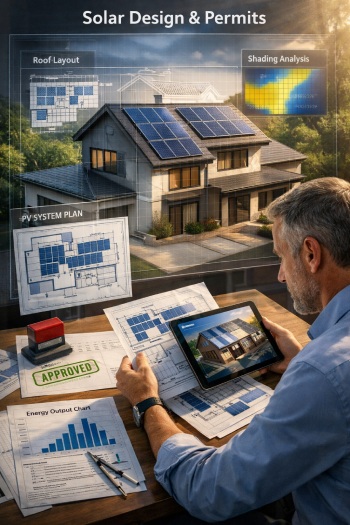
Once the site assessment is completed, and your installer is done with all his findings: for example, the measurements of the roof, the shading data, and your electricity bills, he then does the whole system planning. This phase takes place mostly in-house and usually lasts for some days before anything is put down on paper.
System Design and Production Estimates
Panel count is driven by two things: how much electricity your household uses and how much usable roof space is available. A home averaging 1,100 kWh per month might need somewhere between 20 and 28 panels, depending on their wattage rating and local sun hours. Placement follows the shading analysis, with south-facing roof sections prioritized in most of the US. Inverter type is chosen based on system size and roof complexity. String inverters work well on simple rooflines; microinverters or power optimizers are often recommended when shading or multiple roof angles are involved. If you're adding battery storage, that gets factored into the design at this stage too, affecting both equipment selection and total system cost.
Proposal Review, Pricing, and Contract Details
Your installer will send a proposal that includes system drawings, projected annual output, equipment specs, and pricing. Read through the production estimate carefully - it should reflect your actual usage, not a best-case scenario. Financing terms, whether that's a loan, lease, or cash purchase, will be outlined here as well. Before signing, confirm what warranties cover the panels, the inverter, and the workmanship separately, since these often differ.
Permits, HOA Submissions, and Utility Interconnection Paperwork
After you sign, the paperwork phase begins. Your installer files for a building permit with your local authority, submits plans to your HOA if required, and initiates a utility interconnection application. Permit approval alone can take anywhere from two to eight weeks, depending on your municipality's workload. Utility interconnection approvals sometimes run even longer. There's no visible activity at your home during this period, which can feel frustrating, but there's no skipping it.
What to Expect on Solar Installation Day
For most homeowners, this is the day the project finally feels real. Knowing what's coming makes it considerably less stressful.
Pre-Installation Preparation
A day or two before the crew arrives, clear the area surrounding your electrical panel and ensure that attic access is within reach. Remember that the installers must go through a portion of your home, so a pathway devoid of debris will give everyone his or her own time. You do not have to revolve your life schedule around this small preparation that will make the movement easy.
Delivery of Materials and Crew Arrival
Expect the crew early, often between 7 and 8 a.m. A delivery truck may arrive separately with panels, racking hardware, and the inverter. The team will typically set up a staging area in your driveway or yard, so some outdoor space will be in use throughout the day. Someone should be home for the initial arrival to confirm access points and answer any last-minute questions, though you don't need to supervise the work itself.
Mounting Hardware and Panel Placement
Roof work comes first. The crew attaches mounting brackets directly to your roof rafters, using flashing and sealant around each penetration point to protect against water intrusion. This is the noisiest part of the day, involving drilling and occasional hammering. Most homeowners describe it as comparable to having a roofer on site. Panels are then lifted and secured to the racking system in rows. For a standard 6 to 10 kilowatt residential system, this phase typically takes four to six hours.
Inverter, Battery, and Electrical Work
Once panels are secured, the electrical team connects wiring through the roof into your home and installs the inverter near your main electrical panel. Your power will be shut off briefly during this phase, usually for 30 to 60 minutes. If a battery is part of your system, expect this stage to run longer. Battery installation adds two to four hours on average.
Cleanup and Immediate Post-Install Checks
Most residential installations wrap up in one to three days. Larger roofs, steep pitches, or complicated electrical setups can push that to four or five days, and wet weather may pause roof work entirely. Before leaving, the crew will walk the site, remove all materials and packaging, and do a visual inspection of every panel connection. The system won't be switched on yet - that happens after the utility inspection - but the physical installation will be complete.
Inspections, Permission to Operate, and Going Live
Getting the panels on the roof feels like the finish line, but there are still a few steps between installation day and the moment your system actually starts powering your home.
The Local Inspection
After your installation crew finishes their job, your installer will schedule the building or electric inspection with your local municipality. An inspector comes by to verify adherence to standard code, your electrical connections, your mounting and wiring installation. Ordinarily, it is observed anywhere between a few days to two weeks after installation, depending on how swamped your municipality inspection office is. If all those checks out, we may proceed to another stage with a stamp of approval. If there is a minor infraction still hanging, simply leave it to the installer to sort it out and reschedule.
Utility Approval and Meter Changes
Passing inspection is not the last hurdle. Before your system can be turned on, the utility must grant what's termed PTO, or Permission to Operate. This application is separate from a municipal inspection and is entirely under the utility's control. Most utilities process PTO applications within a week or two, but some take three or four weeks, or even longer when they hit high-volume periods. The utility may also change out your existing meter and put in a meter that runs bidirectionally, measuring what you are consuming as well as any surplus you are sending back to the grid under net metering.
Activation and Homeowner Handoff
Once PTO arrives, your installer activates the system. From that point, your home is running on solar. Before the crew leaves, they should walk you through everything you need to manage the system going forward. Expect to receive the following at handoff:
- Monitoring app access and login credentials so you can track daily production
- Emergency shutdown instructions for the system
- Copies of all warranties, including panels, inverter, and workmanship
- Contact information for your installer if output looks abnormal or an alert appears
Typical Timeline From Contract to Completion
Understanding how long each phase takes helps set realistic expectations and reduces uncertainty. While timelines vary by location and project complexity, most residential solar installations follow a fairly consistent sequence. From signing the contract to system activation, the entire process usually spans one to three months, with most of that time spent waiting on approvals rather than physical work.
The early stages move quickly, with consultation, site assessment, and design often completed within one to two weeks. After that, progress depends heavily on external approvals. Permitting alone can take anywhere from two to eight weeks, and utility interconnection adds additional time. Installation itself is the shortest phase, typically completed in one to three days, followed by inspection and final approval.
Average Timeline Breakdown
Most projects begin with consultation and site assessment, which typically take a few days to two weeks depending on scheduling. System design and proposal review follow shortly after and are usually completed within one week. Once the contract is signed, permitting and utility paperwork begin, often becoming the longest stage in the process.
Installation is relatively quick by comparison, often finished in a single day for standard systems. Inspections typically occur within one to two weeks after installation, followed by utility approval and Permission to Operate. Altogether, homeowners should expect a total timeline of four to twelve weeks, with variability driven mostly by local permitting and utility response times rather than installer availability.
The Process Is Slower Than the Work
Unbeknownst to many homeowners, the solar system physical install itself will only consume one or sometimes two days, with design approvals, permits, utility coordination, inspections, and other surrounding elements adding length abnormally to the timeline. These pending points can cumulatively take several weeks and are largely in the hands of entities other than the installer. Having a clear sense of these factors can ease any tensions because they no longer remain above one’s true estimate. Permit approvals, for example, could take four to six weeks. Utility coordination may further expand this process. You perform the task of document review, provision of work, and prompt response. If homeowners are informed about the timeline at the beginning, it is likely that much less frustration will prevail.
A public park bench in China equipped with solar panels can generate electricity to charge mobile devices, using stored solar energy to provide a convenient power source for visitors.
— Science girl (@sciencegirl) March 30, 2026
pic.twitter.com/skaYLjsEMQ